Construction projects often look well-managed from the outside, but behind the scenes, teams struggle with disconnected tools, delayed updates, and budget confusion. The majority of companies try to fix this using an ERP solution for construction industry tools or separate project systems- but which one actually works better?
The real challenge is not choosing one over the other. It is about knowing how both systems fit into daily operations. This is exactly where platforms like Bouwflow start to change the conversation by bringing everything into one place.
To know in-depth details, stay tuned with us!
ERP Solution for the Construction Industry
So what is construction erp software? A construction ERP software handles business operations for construction business such as finance, procurement, and daily operations. ERP systems help manage entire business elements in one place. This helps connect different departments and ensure that data flows smoothly across the organization.
Key functions across departments and workflows
ERP acts as a central hub for important business activities, including:
Accounting and financial tracking
Supplier and procurement management
Customer and project data
Benefits of ERP for construction companies
ERP helps companies gain better control over their operations by:
Improving the visibility into expenses and performance
Reducing the manual tasks and repetitive work
Supporting faster and more informed decision-making
With these benefits, the construction business can simply manage projects more efficiently and keep budgets under control.
What Is Construction Management Software?
Project management software for construction projects is designed to manage daily site activities. Simply put, it focuses mainly on project execution. It helps teams organize tasks, timelines, and responsibilities. The goal is to keep projects on schedule.
Core construction management software features overview.
Common construction management software features include:
Scheduling to plan project timelines
Task tracking to monitor progress
Resource allocation to manage teams and materials
These features help managers stay in control and faster respond to changes during the project.
How it supports on-site project teams
These systems allow site teams to share updates in real time. They improve communication between field workers and office staff. This leads to better coordination and fewer delays.
Key Differences Between ERP and Construction Software
Although both systems support construction companies, they serve different purposes. Understanding these differences helps businesses choose the right solution.
A related question worth answering here: what is the difference between construction accounting software and a construction erp?
Accounting software focuses narrowly on bookkeeping, invoicing, and financial records, while a construction ERP covers accounting alongside project management, procurement, supplier relationships, and CRM: accounting is one module inside a broader ERP, not a replacement for it.
Limitations of Using Separate Software Systems Together
Initially, running independent software solutions might look like an effective solution. As the project progresses, it becomes increasingly difficult to bridge the gap between various software systems and teams involved in their operation. Rather than increasing efficiency, it brings about numerous misunderstandings and delays.
Data silos and duplicate data entry
When systems are not connected, the same data must be entered multiple times. This increases the chances of errors and creates inconsistency across teams. Over time, it becomes tough to maintain accurate records.
Lack of real-time visibility
With separate tools, information is not updated in one place. Managers may miss the crucial updates or receive them too late. This makes it difficult to track progress and respond faster.
High costs and inefficiencies
Using multiple systems increases costs for software, training, and maintenance. Teams spend more time switching between tools instead of focusing on work. This reduces overall efficiency.
Why Integrated ERP Solutions Work Better Today
Construction companies today handle multiple projects, teams, and financial processes at the same time. Using separate tools makes it harder to stay aligned. Integrated ERP solutions solve this by connecting all operations into one system, making work faster and more organized.
Unified project and business operations
Integrated ERP solutions bring project tracking with core business functions. This removes the gap between office and site teams. It ensures smoother workflows across all stages.
Shared real-time data access
With one system, everyone works with the same data. Updates happen instantly, which improves communication. Teams can respond quickly to changes.
Better control through financial integration
Linking financial data directly with projects enhances tracking and accuracy. With construction accounting software integration, teams can simply track expenses and budgets without delays.
How Bouwflow Combines ERP and Project Management
Construction companies often struggle to balance project execution with venture operations. Using separate systems creates gaps between teams, slows down processes, and makes it harder to stay in control. As projects become more complicated, the need for a unified solution becomes clear. This is where Bouwflow stands out. We offer a more practical approach by bringing everything into one streamlined system.
All-in-one platform for construction businesses
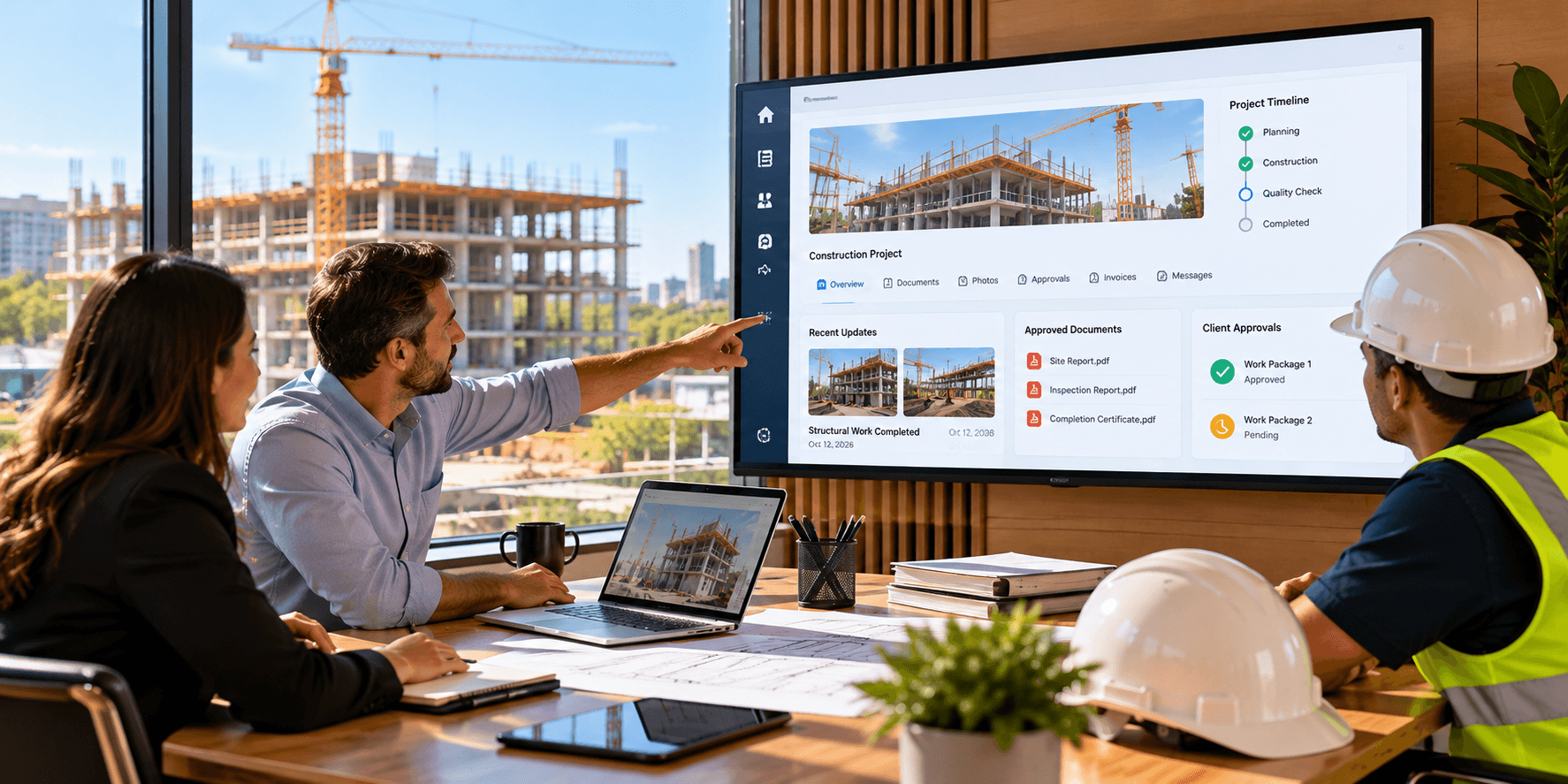
Bouwflow combines ERP and project management software for construction into a single platform, functioning as true construction management erp software rather than two separate systems bolted together. It helps companies manage projects, finances, and workflows without switching tools.
Key features that support end-to-end workflows
The platform facilitates planning, invoicing, procurement, and reporting. It connects each phase of the project from beginning to end. This guarantees seamless performance throughout the process.
Advantages for contractors, builders, and developers
Building experts can streamline their processes using data that is consolidated in one place. It cuts down on unnecessary labor and increases transparency.
How to Choose the Right Software for Your Needs
Selecting the right software is not only dependent on its capabilities; it must also meet your requirements and be suitable for your needs and objectives. In most cases, choosing poorly could result in wasted time and increased costs. Therefore, an assessment will assist you in selecting appropriate software for your immediate and future projects.
Business size and project complexity
Small teams may need simple tools, while larger companies require full ERP systems. The choice depends on how complex your projects are.
Check integration and scalability capabilities
Your solution must be able to grow along with your business and integrate well with other programs for easier development.
Focus on ease of use and cloud accessibility
An easy-to-use platform will make adoption easier, while cloud availability will allow teams to use it from any point of the globe.
Before making a final decision, it is also helpful to understand how ERP connects with financial systems in construction.
You can explore this in more detail here: How to Integrate Cloud ERP With Construction Accounting Software?
The Final Verdict
ERP and project management systems both have their importance for businesses. While the former manages the whole company, the latter manages project implementation in the field.
Nonetheless, not integrating these two systems may lead to information and communication issues. That is why an integrated solution has become much more popular lately. That is where Bouwflow comes up with its unique combination of the best of both worlds. Increased visibility and better coordination, combined with decreased manual labor, mean increased efficiency.