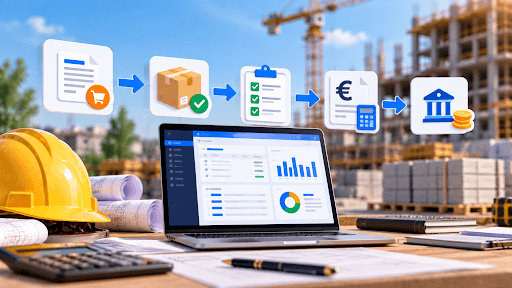
The growing focus on the customer experience and intelligence in data has blurred the line between CRM in construction and ERP systems. In the past, CRM systems mainly focused on managing relationships, but not anymore.
Systems for CRM analytics allow us to connect the two worlds bringing information on the consumer to the operational core of a company.
Integration of CRM analytics with ERP systems provides an opportunity to correlate consumer intelligence with operational information which contributes to better forecasting and estimation of demand as well as optimize business processes in a way of fulfilling the customer requirements. Due to the process of digitalization which has taken place in the construction industry allowing construction companies to integrate CRM data with ERP systems gives a chance to successfully cope with customers' expectations and changes on the market.
In this regard, let’s see what role the CRM analytics play in construction ERP and if it can help with smarter decision-making.
Let’s explore. Keep reading!
Why CRM Matters in Construction ERP
Construction companies do not manage customers separately from their projects. A new lead can become a quotation, the quotation can become a project, and the project can later generate invoices, payments, and repeat business.
That is why CRM becomes more useful when it is connected with construction ERP. Instead of keeping customer management information in one system and project information somewhere else, construction businesses can work with connected information across sales, projects, planning, quotations, invoicing, and financial processes.
For example, a contractor may want to know which customers are most likely to start another project. The answer may depend not only on previous communication, but also on completed projects, quotation history, project value, payment records, and the type of work previously delivered.
This is where CRM analytics can support better business decisions. It gives construction teams a broader view of the customer and the work connected to that customer.
What Data Can CRM Analytics Use in Construction ERP?
Without a doubt, integrating CRM analytics with construction ERP provides valuable information for decision-makers. However, the value of CRM analytics depends heavily on the quality and range of data available to the system. Construction businesses generate large amounts of information throughout the customer and project lifecycle. CRM analytics can bring together data such as:
Customer and company information
Lead and sales pipeline data
Previous project history
Contract values and project types
Customer communication records
Proposal and quotation activity
Change request history
Project timelines
Payment and receivables information
Customer service interactions
Project profitability data
Resource and equipment requirements
When this information is connected with ERP modules, businesses can move beyond basic customer reporting and create a more complete picture of business performance.
How Does CRM Analytics Support Smarter Decision-Making?
CRM analytics integrated with construction ERP gives decision-makers a detailed project overview. They can get a connected view of customers, projects, finances, resources, and overall business performance. With this, decision-makers no longer need to rely on historical data and can use real-time insights to identify opportunities, anticipate challenges, and make more informed decisions throughout the project lifecycle.
Accurate Demand Forecasting
The data within CRM analytics has important client information which includes purchasing behavior, types of projects, market trends, sales activity, and others. Understanding such data allows construction companies to better predict demand and make more informed decisions.
Better Cost and Profitability Control
If a construction company connects its CRM sales information to its ERP financial system, it enables a good understanding of the profitability of the completed projects. Project managers will be able to compare the construction cost calculation software and check the margin as well as pinpoint project components affecting overall profitability.
Proactive Risk Identification
CRM Analytics is able to identify problems that keep happening again such as slow approvals, bad subcontractor performance, deviations from contracts, safety problems, or roadblocks in progress. Tracking project information and risks in a connected system can help construction teams identify issues earlier. This gives decision-makers a chance to find these patterns ahead of time and solve the problems before they are serious and costly.
Stronger Client Retention
CRM analytics can reveal client preferences, communication patterns, project history, and previous interactions. Construction firms can use these insights to identify opportunities for repeat business, improve client engagement, and develop more personalized service strategies.
Smarter Resource Allocation
Connecting CRM forecasts with ERP resource and project data helps organizations align labor, equipment, materials, and procurement activities with upcoming and active projects. What this does for a construction business is that it reduces resource shortages, avoids unnecessary purchases, and improves overall utilization.
Improved Project Performance Visibility
Integrating customer, sales, and project data gives management a broader view of project health. Decision-makers can track factors such as project progress, client satisfaction, change requests, budget performance, and delivery timelines from a more connected perspective.
Better Cash-Flow and Payment Forecasting
Decision-makers can take advantage of the CRM analytics data to gain insights into client payment behavior, contract values, sales pipelines, and upcoming projects. Additionally, when ERP financial data is combined help businesses anticipate revenue, monitor receivables, and plan cash requirements more effectively.
When CRM analytics and construction ERP work together, it does wonders for the businesses involved in construction activities. It reduces the dependency of decision-making on assumptions and isolated spreadsheets. Organizations can connect customer intelligence with operational and financial data to make more informed decisions across different business aspects.
Role of CRM Analytics Improves Construction ERP Workflows
Most construction businesses think that the benefits of CRM analytics are limited to reporting. However, when integrated properly, analytics can become part of everyday construction workflows.
For example, a new sales opportunity can trigger a series of actions within the ERP system. Once an opportunity reaches a particular stage, teams may be able to review resource availability, estimate project costs, assess financial requirements, and prepare operational plans.
In addition to this, customer payment data can be connected with construction accounting software integration to help teams monitor outstanding receivables and follow up when required. This allows construction companies to create a more connected flow of information between sales, finance, project management, procurement, and customer service.
What Should Construction Businesses Consider Before Implementing CRM Analytics?
So by now you have understood that CRM analytics can provide valuable insights. However, construction businesses should consider their data and operational requirements before implementing the integration of CRM analytics and ERP systems.
First, the organization needs clearly defined business objectives. The system should be designed around specific goals such as improving project profitability, forecasting demand, increasing customer retention, or improving resource utilization.
The next important point a construction organization should consider is data quality. Keep in mind that inaccurate, incomplete, or duplicated information can reduce the reliability of analytics.
Businesses should also ensure that their CRM and ERP systems can exchange relevant information effectively. The integration should connect the right data without creating unnecessary complexity for employees.
Lastly, employees at different levels of a construction organization should be trained to understand and use analytics effectively. A dashboard only creates value when decision-makers know which metrics to monitor and how those insights relate to business actions.
How Can CRM Analytics Shape the Future of Construction ERP?
The future of construction ERP software looks bright as it moves towards more connected and data-driven operations. And as businesses generate more customer, project, financial, and operational data, CRM analytics will become increasingly important to turn that information into actionable insights.
Without a doubt, future construction ERP solutions can combine CRM analytics with automation, predictive analytics, artificial intelligence, and real-time reporting. This helps in identifying repeated patterns earlier, automating repetitive decisions, improving forecasting, and providing more personalized customer experiences.
For a construction organization implementing CRM analytics For ERP system, the objective should not be limited to data collection. But to collect the right information and make it useful for the people responsible for business and project decisions.
How Does Bouwflow Support CRM Analytics in Construction ERP?
Bouwflow helps construction companies connect customer information with everyday project and business processes. Instead of keeping customer details, quotations, projects, planning, work orders, and invoicing in separate systems, teams can manage these activities through one construction-focused ERP environment.
This connection can give construction businesses a clearer view of their customers and ongoing work. For example, customer information can support quotation management, while project and planning data can help teams understand what work is coming up and what resources may be needed. This makes it easier to use customer and project information when making day-to-day business decisions.
Bouwflow also brings together important construction processes such as CRM, customer management, quotations, calculation, planning, work orders, invoicing, and accounting integration. This helps reduce the need to move information manually between different tools and gives teams a more connected view of their operations.
For example, when a potential customer moves from the quotation stage to an active project, the relevant customer and project information can remain connected to the wider workflow. Teams can then work with project details, planning activities, work orders, and invoicing as the project progresses.
This is useful for construction companies handling multiple customers and projects at the same time. Managers can use available customer and operational information to review current work, identify priorities, follow up with customers, and keep business activities organized.
Bouwflow can therefore provide the foundation for using CRM information alongside construction operations. Rather than treating customer data as something separate from project management, businesses can connect it with the processes that happen before, during, and after a construction project.
Conclusion
When construction erp with analytics work together, construction businesses can reduce their dependence on assumptions, disconnected spreadsheets, and isolated departmental data.
Organizations can connect customer intelligence with operational and financial information to improve forecasting, resource planning, project visibility, profitability monitoring, and customer relationships.
For construction companies managing multiple projects, customers, teams, and resources, this connected approach can make business information easier to understand and act upon.
As construction businesses continue to digitize their operations, CRM analytics integrated with ERP can become an important part of building more data-driven and connected workflows.
Thinking about taking your construction business ahead with a smarter ERP system? Contact us for ERP solution development with advanced CRM integration tailored to your business requirements.
Frequently Asked Questions
1. How does CRM analytics enhance construction ERP decision-making process?
CRM analytics integrates customer, sales, project, finance, and operational data in the ERP system. It enables the management to get an insight into business performance, to find trends, to predict the demand, to control profitability, to distribute resources, and to solve potential problems.
2. What type of data can be analyzed by CRM analytics in construction ERP?
The following data can be analyzed by CRM analytics: customer data, sales pipeline, project history, contracts value, communication history, quotations, change requests, payment transactions, profitability of the project, resource needs. Integrating this data with ERP data will give additional insights on customers and projects.
3. Can CRM analytics help construction companies forecast project demand?
Yes. CRM analytics can help to analyze sales activities, customer behavior, historical projects, types of projects, and market patterns that may show potential demand. Construction companies can use this information to plan workforce, equipment, materials, and other resources needed for the projects.
4. In what way CRM analytics can contribute to construction project profitability?
Integration of CRM sales and customer-related data with ERP finance data allows for comparison of contract price, estimates of cost, real expenditures and margins in projects. This provides an opportunity to understand less profitable projects and make changes accordingly.
5. Is CRM analytics able to reveal the risks in construction projects?
Yes. Through analytics, the patterns may be identified such as approvals delays, repeated requests for change, payment troubles, bottlenecks in project execution, communication difficulties, etc. Thus, construction teams will have an opportunity to research possible risks and prevent them.
6. What aspects should construction businesses consider before integration of CRM analytics with ERP?
These companies need to define goals of integration, keep their data up to date, provide the opportunity for exchange of necessary information between CRM and ERP systems and train employees on effective usage of analytics.
7. What would be the future of CRM analytics in construction ERP?
The future of CRM analytics in construction ERP lies in its connection to automation, artificial intelligence, predictive analytics, and real-time reporting. This will give opportunities to detect patterns, make forecasts, automate routine procedures and make decisions based on more relevant data.