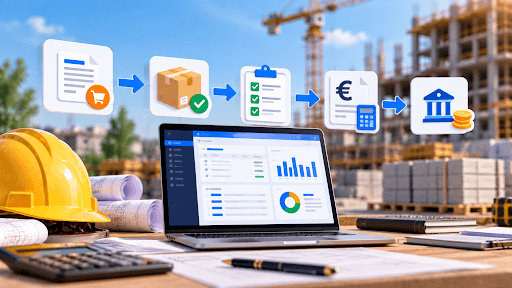
In construction, work usually follows steps. One task finishes, then the next one starts. This sounds simple, but in real projects, these steps are not always connected.
For example, a task may be completed, but the team who are supposed to follow the next step does not know. An approval is needed, but no one gets notified. Because of this, work slows down even when people are doing their job.
This is where digital workflow automation helps, especially when supported by construction workflow software. It connects each step, so work can move forward without waiting. Instead of depending on reminders, the system keeps things moving.
In this blog, we will understand how construction work flows and how automation makes it smoother.
Construction Work Follows the Same Steps Over Again
Most construction projects follow a similar path. The type of project may change, but the steps are often the same.
A simple example looks like this:
Plan-> Approve->Build-> Check->Bill
These steps repeat in almost every single project. Even when teams work on different sites, the basic flow stays similar. However, the issue is not the steps. The problem is that these steps are handled each time differently. One team may follow a proper order, while another may skip or delay certain steps.
Due to this, work becomes inconsistent. Even easy tasks may not move in the same way every time.
Also Checkout: Role of Automation in Construction Project Lifecycle
What Happens When Steps are not Fixed
When there is no fixed flow, work becomes unclear. Teams start working in their own way. This creates confusion. Sometimes, people are not sure what to do next. They may wait for instructions or keep asking for updates. In other cases, tasks may be done twice or missed completely.
Also, the result depends more on the person than the process. If someone is experienced, work moves well. If not, delays and errors increase.
With time, this makes projects harder to manage. Even the small tasks start taking more time than expected.
What Automation Does in Simple Terms
Automation is simply connecting all actions together. Once one action is completed, the next action is automatically initiated without any follow-up prompts.
For instance:
Action 1 is completed → Action 1 is recorded → Action 2 is assigned → Work is processed further
The process becomes predictable with the support of construction cost estimating software. Teams will know the next course of action without any assumptions. The automated system controls the whole process.
Automation streamlines the process where manual intervention is not required.
Turning Work into a Step-by-Step Flow
Step 1: Task done
Step 2: Update saved
Step 3: Approval starts
Step 4: Next task assignedStep 5: Progress recorded
In this flow, every step is connected. When the task is completed, the system saves the update. This triggers the approval step. Once approved, the next task is assigned automatically. At the same time, progress is recorded using construction project tracking software.
This step-by-step flow creates a chain where each step leads to the next movement. Nothing is missed, and no step is skipped. It also reduces confusion because everyone knows where the project stands.
How Automation Helps in Daily Work
In daily work, small delays often cause huge issues. Automation helps reduce these delays.
First, tasks move faster. Teams do not have to wait for instructions. Once one step is done, the next one starts.
Second, there is less confusion. Every team member can see what is happening and what comes next.
Third, teams do not need to follow up over and over again. The system manages updates and notifications.
This makes daily work smoother and simpler to manage.
From Messy Work to Smooth Flow
The absence of an automated system results in randomness in terms of task execution. At times, tasks are done very quickly, whereas other tasks are hindered at certain stages. Much time is spent on monitoring tasks rather than on carrying out actual work.
However, the introduction of automation ensures that the process of task execution occurs smoothly and in sequence, making the whole process easier to monitor.
Such a transition proves to be vital since employees become much more confident as they understand what is going on and managers gain control without any additional efforts on their part.
Where Automation Is Used in Projects
The implementation of automation technology plays an integral role in the improvement of specific stages within the process of building construction. This allows streamlining of various activities on the whole.
Therefore, once a certain job in the area has been done, the system will be able to document the change immediately. There is no need for one to have to update the other members of the team manually. The same applies when it comes to getting approval as the individual concerned will receive the notification immediately.
Moreover, automation enables effective coordination between various teams of specialists. Upon the completion of work by the first team, another team will receive detailed instructions regarding the current status of the process.
What is more important, the billing stage will be better linked with the work done by specialists using construction invoicing software. Thus, payments will be made promptly as soon as a certain task is finished. These changes may seem small on their own, but together they create a smoother and more trusted workflow across the entire project.
Conclusion
At the end, construction does not need to feel rushed or disorganized to get outcomes. When the flow of work is clear, teams can focus better and complete tasks with more confidence.
Digital workflow automation helps bring this clarity by turning everyday steps into a connected process. With a system like Bouwflow, an ERP solution for the construction industry helps businesses move toward a more structured way of working where tasks flow naturally and projects stay on track without constant effort.
FAQs
How does automation differ from simple software utilization?
Simple software assists in storing or managing data, whereas automation links tasks and advances them automatically without any effort on your part.
Is it possible to use automation with your current process?
Indeed, automation is based on your current workflow. It simply enhances connections between tasks without changing anything.
Won’t automation make the process too strict?
Absolutely not! Workflows can remain flexible. Automation is there to introduce clarity into the process.
How much time does it take before you start seeing benefits from automation?
It doesn’t take long before your organization can start observing the benefits of automation.
Is there a need to train employees on how to work with automated systems?
Not necessarily. Modern automated systems are relatively easy to operate.